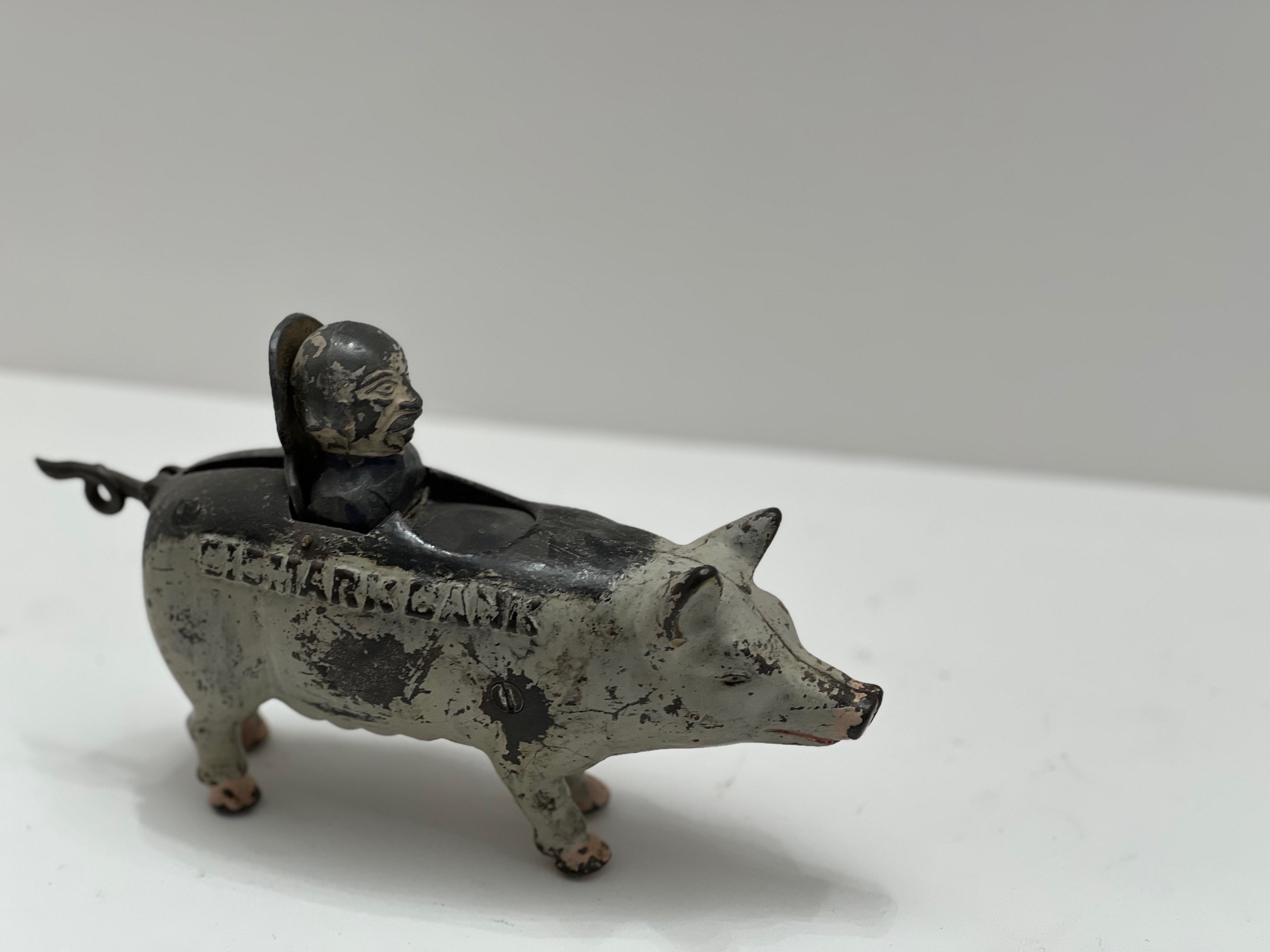
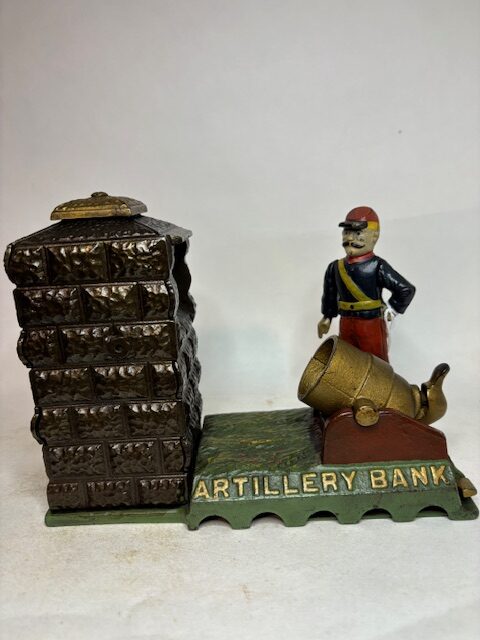
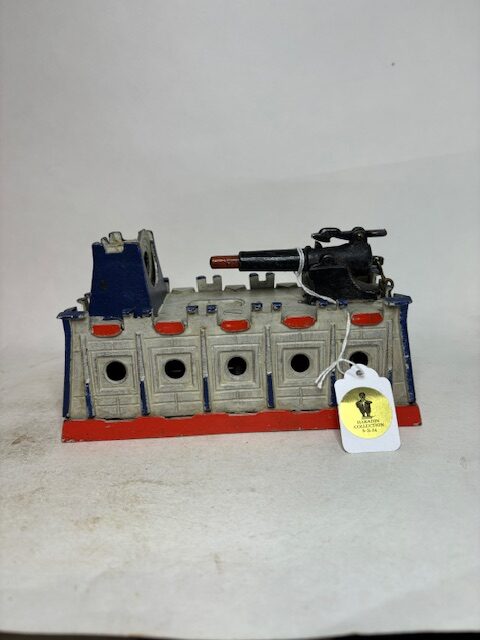
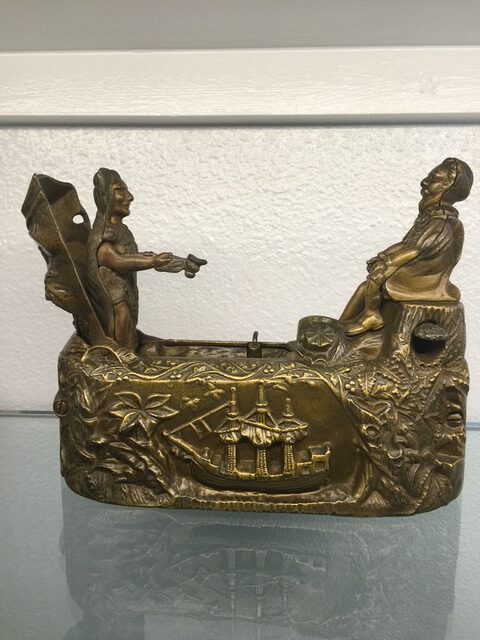
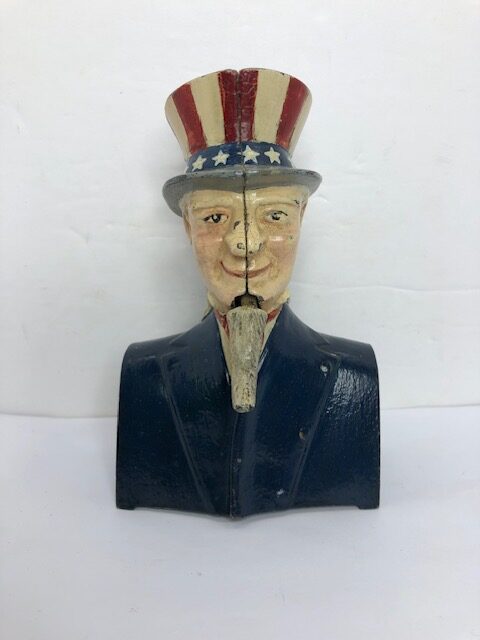
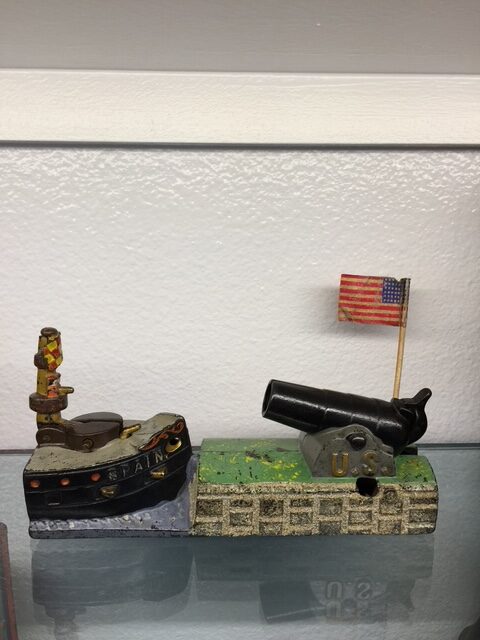
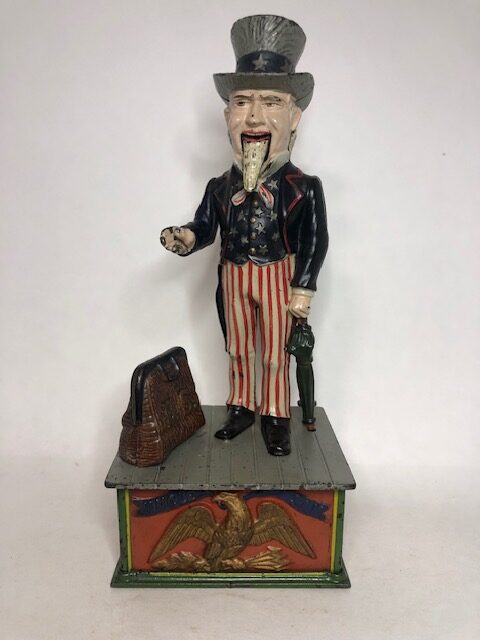
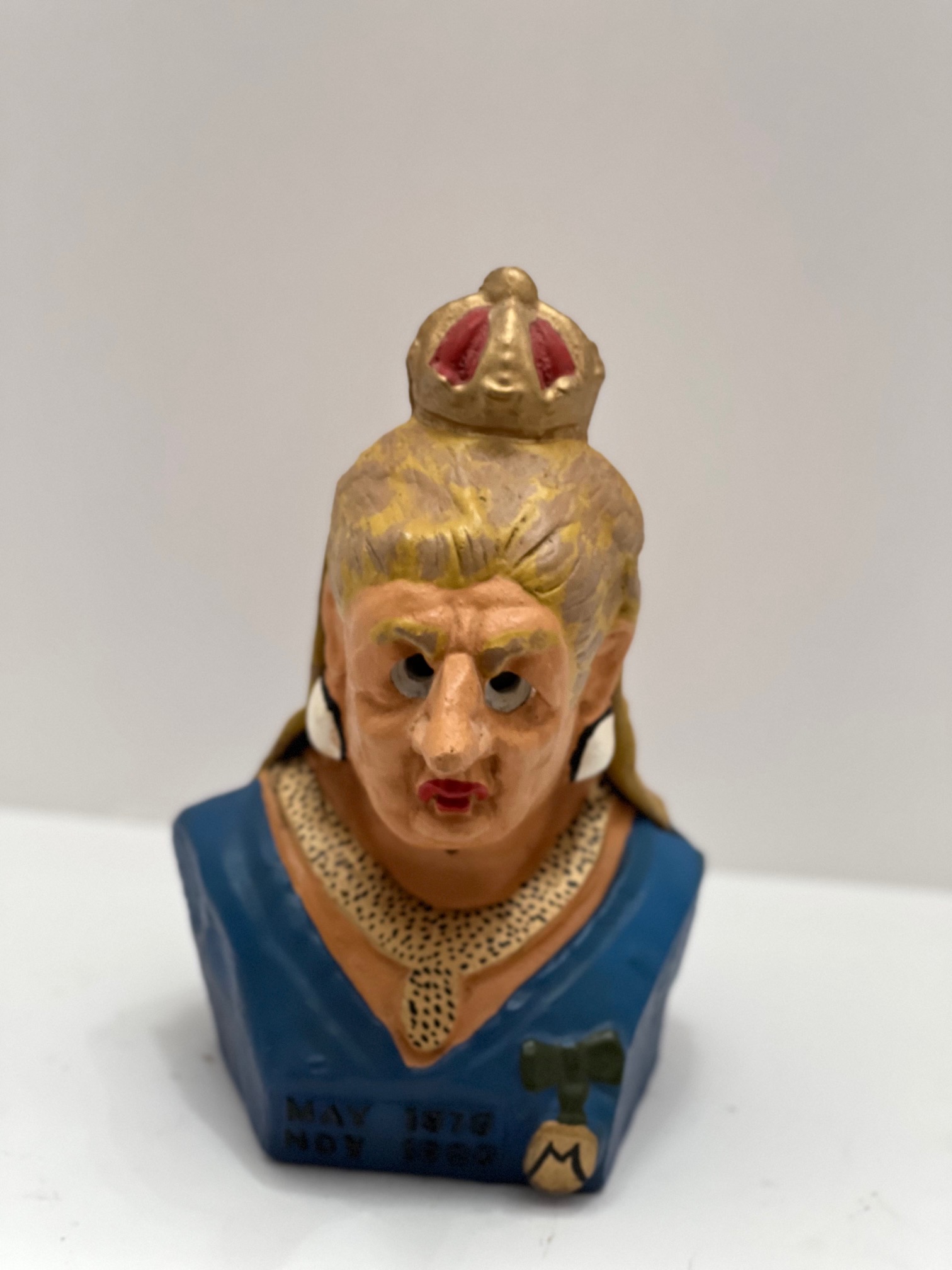
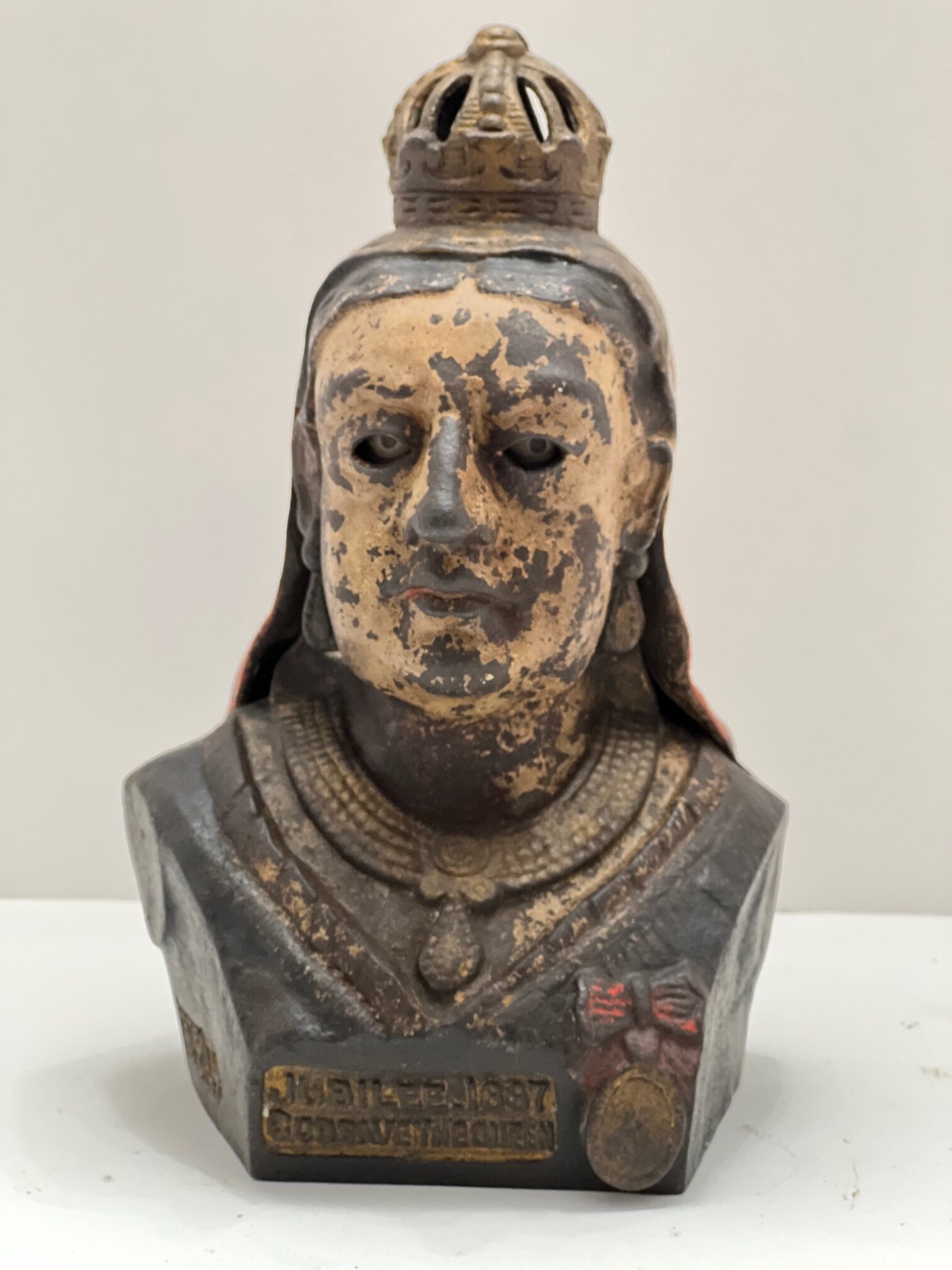
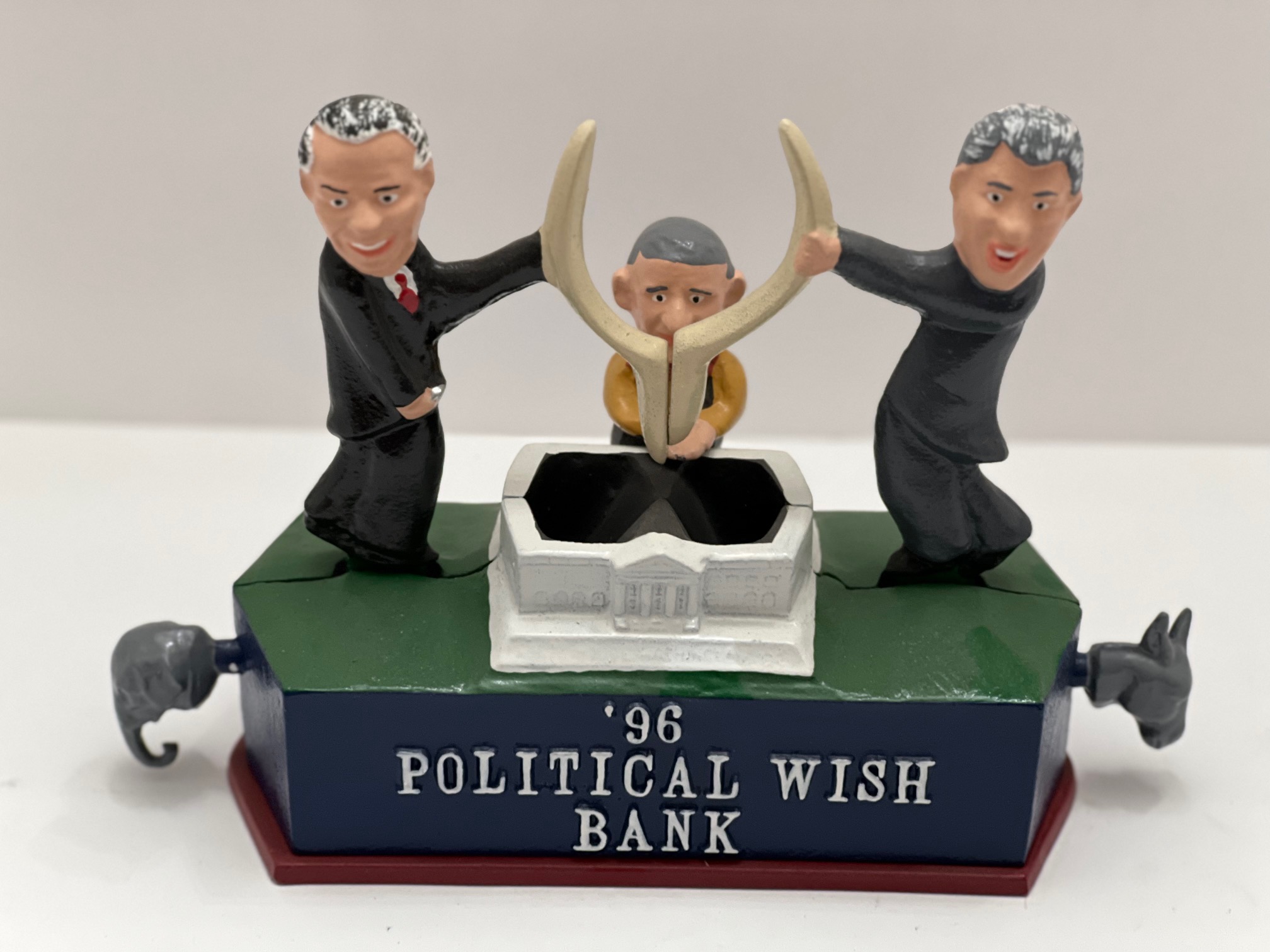
Politics, history, and current events have been a focus of mechanical banks since their inception. The first political bank was the Tammany bank produced by the J&E Stevens Company and meant to be a caricature of the New York Tammany hall leader Boss Tweed. It is activated by putting a penny into Boss Tweeds’s hand and the weight of the penny makes the arm move and drop the coin into his hip pocket. The next and most popular political bank created is the Uncle Sam bank from Shepherd Hardware. Today most of us think of Uncle Sam as a kindly father figure representing the spirit of the United States. In fact, if we look at the bank, he is anything but that. This Uncle Sam was initially created as the archetypical carpetbagger, a northerner who went to the South after the civil war to make his fortune at the expense of the defeated confederacy. We see a figure of Uncle Sam standing next to his carpet bag and holding an umbrella. A penny is then placed in his right hand and when the lever is pressed the carpet bag opens and he drops the penny into it. Presidents and elections have been a common focus. President Theodore Roosevelt and his love of hunting were the subject of two banks, Teddy and the Bear and the Lion Hunter. Other presidents such as Bill Clinton and Barack Obama have also been immortalized by banks. Most recently President Trump has been the subject of multiple banks some being pro Trump and others being anti Trump. Foreign leaders were also depicted such as Queen Victoria, Margaret Thatcher, and Chancellor Otto Von Bismarck. It should finally be noted that from the 1980s to the early 2000s, the modern bank designer, Charles Reynolds made a bank every four years to reflect the presidential election taking place. In terms of history, mechanical bank manufacturers would reflect their times going back to the discovery of the New World. The World’s Fair bank made for the Columbian Exposition (World’s Fair) of 1892 depicts Columbus meeting with an Indian. Though not historically accurate it reflected what the common conception of that time was. To coincide with the Centennial Celebration of 1876 in Philadelphia, Enterprise Manufacturing produced the Memorial Money Bank which features the Liberty Bell. In the same vein for the Bicentennial in 1976 Al Davidson created the Betsy Ross bank. Many wars were documented through the banks.
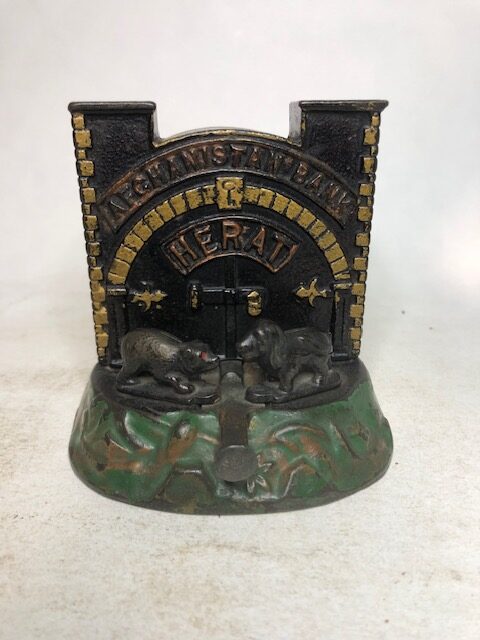
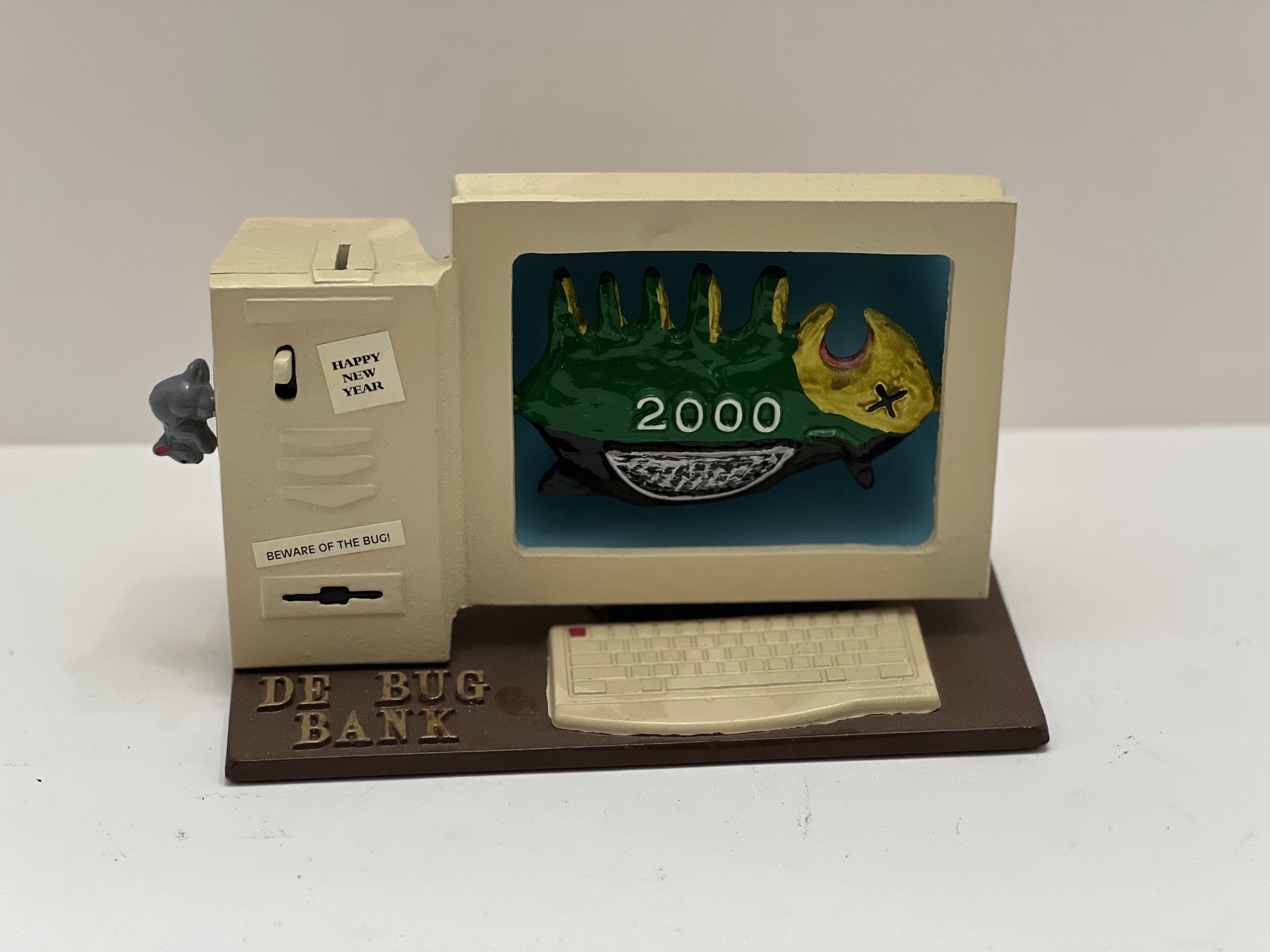
Examples of these are the Artillery banks depicting Civil War Soldiers and which came in Confederate and Union uniforms, the US and Spain bank for the Spanish American war, multiple banks for World Wars One and Two( these being mainly Anti-Hitler banks) and the Afghanistan bank, which symbolically reflected the war between Russia and Great Brittain over the control of Afghanistan. On another theme, the exploitation of Labor and it’s rise was reflected in banks such as the Breadwinners bank, which in one bank shows the relationship of the banker, the manufacturer, and the poor laborer in the first quarter of the twentieth century. More recently smart designers following the headlines developed items they thought would sell. An example of which was the perceived Year 2K Crisis reflected by two mechanical banks.